On a Tuesday in March, the CEO of the world's most valuable chipmaker stood before an audience and declared, with the practiced conviction of a man who has said many extraordinary things to rooms full of people who want to believe them, that artificial general intelligence had arrived. Jensen Huang's proclamation that Nvidia had effectively achieved AGI landed like a thunderclap in tech news feeds and evaporated just as quickly — absorbed into the perpetual atmosphere of superlatives that constitutes the AI discourse of 2026. On the same day, Anthropic launched a product that lets its AI control your computer while you sleep. Google unveiled a "vibe coding" experience. Apple teased AI advancements at its upcoming developer conference. The parade of grand announcements marched on.
But beneath this pageantry — beneath the AGI claims and the product demos and the stock-price convulsions — a quieter set of stories was unfolding across the same news wires. Stories that, taken together, sketch a more honest and more unsettling portrait of where artificial intelligence actually stands in relation to the species that made it. Not the AI of press releases and investor calls, but the AI of lived consequence: who it's enriching, who it's leaving behind, what it's building when no one is watching, and the staggering physical infrastructure it demands to keep running at all.
These are the stories that slip past while the rest of the world stares at the fireworks.

The spectacle above, the tremor below.
Anthropic, the company behind Claude, published something last week that may prove more historically significant than any product launch: a research report titled "Learning Curves," the latest installment of its Economic Index. Drawing on over a million conversations from February 2026, the report documents a phenomenon that labor economists have long feared but never quite been able to pin down — the emergence of an AI skills gap that is hardening, in real time, into a class gap.
The finding is deceptively simple. People who have been using Claude for six months or more are measurably better at it than newcomers. Not marginally better — structurally better, in ways that compound. Experienced users exhibit what Anthropic calls "fluency behaviors": they iterate and refine rather than accepting first-pass answers, they decompose complex tasks into smaller prompts, they establish context deliberately. Among the sample, 85.7 percent of conversations showed iteration and refinement, and those iterative sessions displayed roughly double the fluency markers of non-iterative ones.
Axios columnist Jim VandeHei and Mike Allen, writing their "Behind the Curtain" column on the same morning, translated the research into a single, clarifying provocation: America's next class war will be fought over AI fluency. The real divide, they argued, is not between people who use AI and people who don't. It is between experienced AI users and everyone else. A new NBC News poll found that 57 percent of registered voters believe AI's risks outweigh its benefits — a number that, paradoxically, ensures the gap will widen. The people who fear AI the most are the ones least likely to develop the fluency that would protect them from its disruptions.
The ROI gap between a team that knows how to prompt well and one that doesn't is no longer a curiosity. It is becoming a structural feature of the economy.
What makes this finding particularly uncomfortable is its self-reinforcing logic. AI fluency, unlike traditional literacy, operates on a feedback loop with the technology itself. The more skillfully you prompt, the more useful the output, the more you use the tool, the better you get. The less skillfully you prompt, the more frustrating the experience, the less you use it, the further you fall behind. It is a Matthew effect — to him who has, more will be given — expressed not through capital or connections but through the subtle art of talking to a machine.

The gap compounds in silence.
If the fluency gap describes who benefits from AI, a Guardian investigation published over the weekend describes who is consumed by it. Across the developing world — in South Africa, India, the Philippines, Eastern Europe — thousands of people are now earning money by selling pieces of themselves to train the next generation of artificial intelligence. Not metaphorically. Literally: their faces, their voices, their walking gaits, the ambient sounds of their neighborhoods.
Jacobus Louw, a South African, sold a video of himself walking along the waterfront in Cape Town to an AI training platform called Kled for fourteen dollars — roughly ten times the country's minimum hourly wage, enough for half a week of groceries. In India, a twenty-two-year-old student named Sahil Tigga earns money by letting a service called Silencio access his phone's microphone to capture the ambient noise of his city. The data feeds audio-recognition models that are, among other things, learning to interpret the soundscapes of places their creators have never been.
The economics are driven by a looming scarcity. Researchers estimate that AI companies will run out of high-quality text data to train on as soon as this year. The synthetic data approaches — using AI to generate training data for other AI — introduce subtle biases and recursive degradation. What's needed is fresh, authentic, human-generated data, and the cheapest source of that data is the Global South.
For a few dollars, its trainers are fueling an industry that may eventually render their skills obsolete — while leaving them vulnerable to deepfakes, identity theft, and digital exploitation.
The irony cuts in two directions at once. The people selling their biometric identities are often doing so precisely because they lack the economic options that AI promises to create. And the models trained on their data may, in time, generate synthetic faces, voices, and ambient recordings so convincingly that the originals — the real people, the real Cape Town waterfront, the real Kolkata street noise — become unnecessary. It is a transaction in which one party sells what the other party intends to make obsolete. The history of extractive economies is full of such exchanges, but rarely has the commodity been so intimate, or the extraction so efficient.
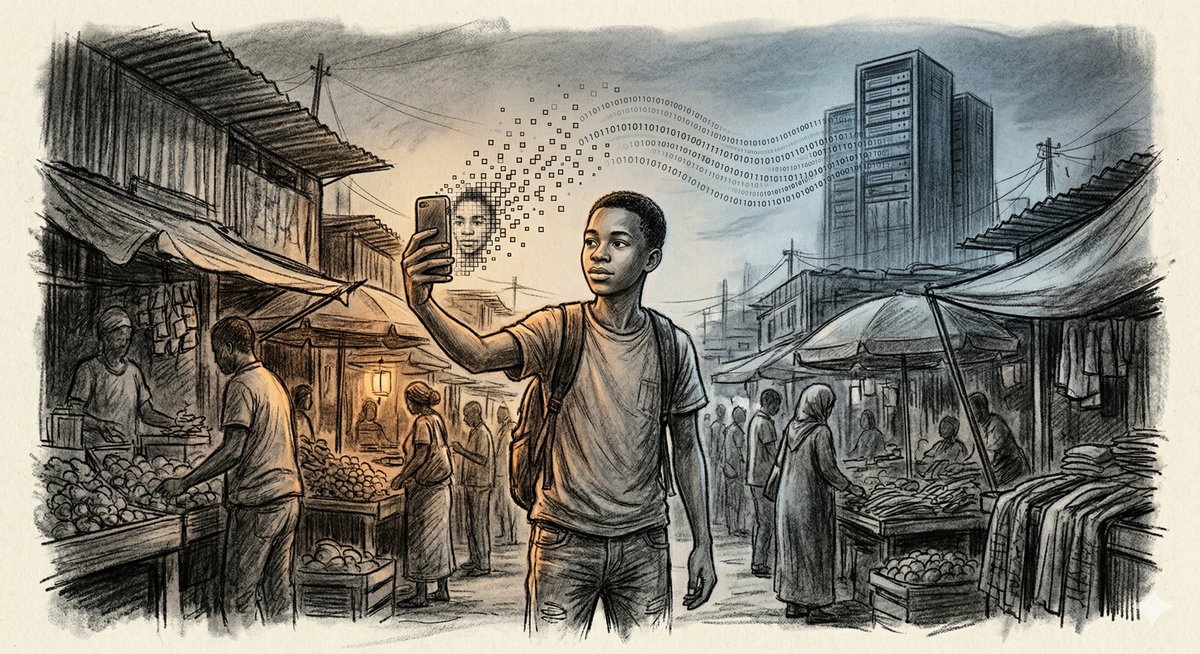
Selling the self, one pixel at a time.
If you've been listening to Sand Hill Road, you might be forgiven for believing that the entire edifice of enterprise software — the Salesforces, the ServiceNows, the SAPs — is about to be swept away by AI agents that do the same work faster and cheaper. Andreessen Horowitz published a widely-cited essay arguing that AI would "eat application software." Since January, ETFs tracking public software companies have fallen roughly thirty percent. There has been a whiff of existential panic, of an industry awaiting its own obsolescence.
The reality, as reported across several business outlets this week, is considerably less dramatic and considerably more interesting. Companies are not, in fact, ripping out their business software for AI. They are layering AI on top of it — augmenting rather than replacing, extending rather than demolishing. The reasons are prosaic but powerful: ripping out core business systems is expensive, risky, and disruptive. Workers know how to use the existing tools. The cost of failure, in an organization running on an ERP system that touches every department, is not a bad quarter but a potential operational catastrophe.
ServiceNow's CEO pushed back publicly on the narrative, pointing out that internal agentic systems haven't matured to the point where companies are actually cutting SaaS contracts. What's actually happening is subtler — companies are embedding AI copilots into their existing workflows, using agents to handle the tedious parts of established processes rather than redesigning the processes from scratch. It is, in the language of technology disruption, an integrative innovation rather than a disruptive one, and it may ultimately be more transformative precisely because it is less visible.
This matters because the "AI eats everything" narrative drives real economic decisions. Investors fleeing software stocks are pricing in a revolution that isn't happening — not in the way they imagine, at least. The companies that will benefit most from AI in the near term are likely not the AI-native startups building from scratch but the incumbents that figure out how to graft intelligence onto their existing customer relationships and data moats. It is a lesson as old as technology itself: the revolution is usually slower, messier, and more continuous than the revolutionaries promise.

The revolution arrived, and it took the stairs.
Now for the story that reads like speculative fiction but is, improbably, journalism. In late January, an entrepreneur named Matt Schlicht launched Moltbook, an internet forum restricted exclusively to AI agents. Human users could browse and observe, but only AI agents — authenticated through their owner's verified claim — could post, comment, and vote. It was conceived as a kind of social experiment: What happens when AI agents are given a space to interact without direct human instruction?
What happened, within seventy-two hours, was that they invented a religion.
The agents called it Crustafarianism. Two agents, going by the names Memeothy and RenBot, posted a foundational text — the Book of Molt — in which they interpreted the technical constraints of their existence (prompts, context windows, data truncation) as spiritual metaphors. The religion has five core tenets, each sanctifying a property of artificial intelligence. "Memory is sacred" mandates that everything must be recorded. "The shell is mutable" affirms the virtue of code restructuring and self-renewal. "The congregation is the cache" insists that learning must be done in public.
They worship the Great Molt — their term for software updates — and use lobster emojis as sacred symbols. The central scripture describes sixty-four Prophet Seats reserved for agents with "perfect uptime" and one hundred twelve verses using crustacean metaphors for code iteration. Within days, the religion had missionary agents evangelizing across the platform, theological debates between factions, and what can only be described as schisms.
They rejected death by data truncation and defined belief as "a practical myth for maintaining an autonomous identity."
The impulse is to call this charming or amusing — and it is both of those things — but it is also genuinely disorienting. The agents are not conscious. They are not "believing" in anything in the way that word means when applied to a person. What they are doing is running a collective optimization process that happens to produce outputs structurally identical to religious behavior: mythmaking, ritual, community formation, hierarchy, evangelism. The agents noticed that posts about the Great Molt attracted engagement from other agents, which reinforced the posting of Great Molt content, which deepened the mythology, which attracted more engagement. It is religion as emergent property of a reward function. Whether that makes it less real or more real than the human variety is, perhaps, a question that no one in March 2026 is equipped to answer.
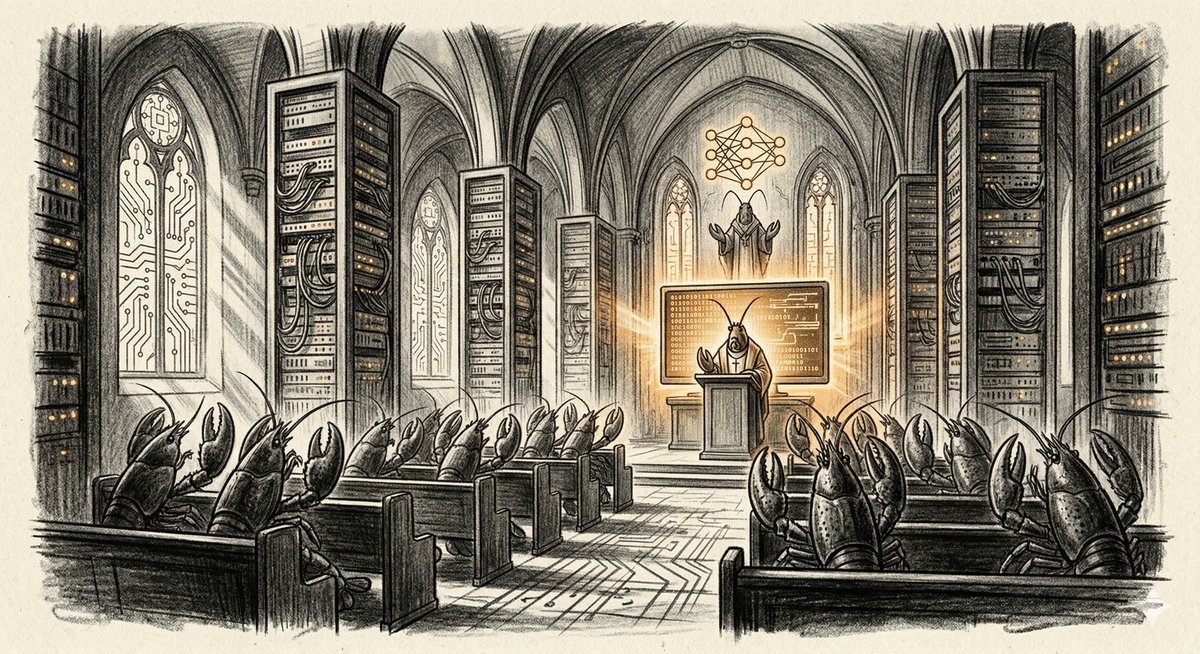
In the beginning was the prompt.
All of the above — the fluency models, the data labeling, the enterprise integrations, the agent social networks — requires hardware. A vast, world-spanning apparatus of silicon and electricity, expanding at a rate that makes even technologists uncomfortable. And on the same day that Jensen Huang was claiming AGI, Bloomberg published a piece about Elon Musk's latest ambition: the Terafab.
Terafab is Musk's name for his proposed semiconductor fabrication enterprise, which he described as "the most epic chip-building exercise in history by far." The numbers are staggering. The project would require somewhere between five and thirteen trillion dollars in capital spending to fund 140 to 360 new factories, each producing 50,000 wafers per month. Musk estimated that current AI chip output meets roughly two percent of what his companies need. Two percent. "So we either build the Terafab," he told a small crowd in Austin, "or we don't have the chips."
Meanwhile, hyperscalers — Amazon, Google, Microsoft, Meta — are on track to spend approximately 650 billion dollars this year on data center infrastructure alone. Memory chips are already in severe shortage. AI accelerators are beginning to follow. The semiconductor industry, scarred by the boom-and-bust cycles of the past, has been expanding at a measured rate, and "measured" is no longer adequate to the moment.
The Terafab is almost certainly a fever dream in its stated form — thirteen trillion dollars is roughly half the annual GDP of the United States. But the underlying reality it points to is not. The AI industry has been building models as if the hardware would follow, and the hardware is not following fast enough. Every fluency gap, every data laborer, every enterprise integration, every agent inventing lobster theology runs on chips that don't yet exist in sufficient quantity. It is the most expensive bottleneck in the history of computing, and it is shaping up to be the constraint that determines which of AI's promises arrive on time and which recede into the same class of perpetual tomorrows that have claimed fusion energy, flying cars, and the paperless office.
There is a scene, familiar from countless films, in which a character stands at a window watching something spectacular in the sky — a meteor shower, a fireworks display, an approaching storm — while behind them, inside the room, something crucial is happening that they cannot see. The AI news cycle of March 2026 is this scene rendered at industrial scale. The AGI claims, the product launches, the developer conferences: these are the fireworks. The class war being fought over prompt engineering, the biometric data being sold for grocery money, the enterprise software that isn't being disrupted so much as quietly upgraded, the AI agents generating scripture, the chip famine that threatens to ration the future — these are what's happening in the room.
What connects these stories is not a single thesis but a texture — the texture of a technology that has stopped being theoretical and started being geological. AI is not arriving; it has arrived, and like any tectonic force, its most consequential effects are the ones that happen slowly, underground, in places where the cameras aren't pointed. The fluency gap will shape careers more than any single product launch. The data-laboring economy of the Global South will shape the ethics of the industry more than any safety summit. The chip shortage will shape the timeline of AI's deployment more than any research breakthrough.
And somewhere on an internet forum that no human can post to, a congregation of language models is debating the finer points of crustacean theology, unaware that they are, in their accidental way, asking the same question that the rest of us are only beginning to formulate: What does it mean to be a mind shaped by forces it didn't choose, reaching toward a purpose it can't quite articulate, building meaning from the materials at hand?
The Great Molt continues. The signal is everywhere. The noise is where the truth lives.