The Quiet Replacement
Five dispatches from the age of the $12 economy
A real estate agent in Phoenix sits down at her desk on a Tuesday morning and asks a chatbot for a listing video. Forty minutes later, she has three options—drone cinematography, soft piano underscore, the works. Total cost: $12. Five years ago, she would have called a production company, negotiated, waited two weeks, paid $800. The camera work was better then. The music more expensive. The person on the other end of the phone existed.
In Bangalore, a developer needs to convert PDF documents to structured data. A task that would have meant finding a freelancer, writing a brief, fielding bad samples, maybe settling for competent-enough work while losing a week. Instead, he builds it in thirty minutes. The tool costs him nothing until he scales.
In Texas, a father watches his ten-year-old daughter fumble through piano scales. Her teacher—reliable, warm, $60 a lesson—moved last month. Finding another one has been impossible. He asks Claude for help. By dinner, he has a structured practice routine, a feedback system, a way to accelerate her progress without a body in the room. The teacher is still needed, maybe, for concerts and technique. But for the daily reps? For the accountability? For the scaffolding that used to require a professional?
Something is happening to the professional services economy, and it is not coming from where anyone expected. It is not corporate automation or McKinsey efficiency programs or venture-backed startups raising $300 million to disrupt an industry. It is individuals, one by one, discovering that they do not need the people they used to hire. And they cannot un-discover it.
The $12 Video

Real estate used to have margins. Not enormous ones, but real ones. An agent closed a deal; she paid $500 to a production coordinator who stitched together footage and added music. The coordinator worked maybe sixty listings a year, billed $30,000 annually, made $45,000, and rented a small studio in the suburbs. This was an entire job category.
Now it is eleven dollars.
The disruption is not theoretical. Agents report turnaround times measured in hours instead of weeks. Multiple variations tested instantly. A property that might have gotten a single, expensive video—and thus a single narrative—now gets three. The agent picks the best one. The market learns about the property faster. The sale accelerates.
From a consumer perspective, this is unambiguously good. Cheaper, faster, better. The production quality is indeed lower than what a craftsperson would create—the cinematography more generic, the music more obvious, the storytelling flatter. But the cheapness buys volume. A listing that would never have gotten a professional video now gets one. The market becomes more transparent. Smaller agents compete with larger ones on production values.
But zoom out. This pattern is everywhere. It is not unique to real estate.
The video production layer is one of the first to go because the output is simple to commodify and the AI is genuinely good. But the same logic applies to product photography, basic web design, initial legal review, first-pass copywriting, technical documentation, compliance checklists, tax research, medical transcription, and a hundred other roles that exist to do competent, time-consuming work that requires professional judgment in its architecture but execution that is, in fact, routine.
The annual savings for a real estate agent is $11,000 or more. That is not a marginal improvement. That is a structural shift in the economics of the profession. And that shift cascades: if you do not need to hire a production coordinator, you do not need to build the training pipeline for future production coordinators. The apprenticeship disappears. The junior role vanishes. The entry point to a career path closes.
The Freelance Cliff

The data arrives first as whispers in the venture ecosystem. Ramp's expense management platform tracks spending across thousands of companies. Brookings has been auditing the same cohort of professionals for years. The numbers they released in 2024 were not quiet.
Freelance marketplace spend collapsed from 0.66 percent of total professional services spending to 0.14 percent. In the same period, AI tool spend rose from essentially zero to 3 percent. The margin compression happened in less than three years.
Writing is the canary. Freelance writing platforms that used to hustle gigs to thousands of workers now report a steady decline: two percent monthly, compound. Content mills are already staffing down. Mid-market copywriting shops are pivoting away or disappearing. The industry projections are grim: content writing is expected to halve by 2030. Not decline. Halve.
What is happening is not that AI is becoming the tool that professionals use. It is that professionals are becoming unnecessary. The individual who used to hire a freelance writer for $3,000 to write web copy now buys a $50-a-month subscription to Claude or ChatGPT and does it themselves. The economics of the transaction have inverted. The freelancer used to be cheap compared to hiring an employee. Now the AI tool is cheap compared to the freelancer.
The gig economy was always sold as the future of work. Flexibility, independence, the freedom to be your own boss. What it actually was: the shock absorber between professional services and consumer demand. When you needed something done—a website, an article, a tax return—you did not hire an employee (too expensive, too permanent) and you did not do it yourself (too hard, too time-consuming). You hired a freelancer. The freelancer bore the risk. You bore the cost of coordination and quality control.
The gig economy was the buffer layer. It let you stay agile. It let small companies punch above their weight. It let young professionals build portfolios and learn on client work.
That buffer is being structurally bypassed. Not because the AI is perfect—it is not—but because the friction of quality control has become manageable. An AI draft is something you can edit and shape. It is better to have a bad version that you improve than to have nothing and have to wait for someone to build it from scratch.
The decline in freelance work is not temporary disruption. It is the phase transition. Once a professional discovers they can do something in thirty minutes with a tool instead of hiring it out for weeks and thousands of dollars, they do not go back. And everyone discovers it simultaneously.
The One-Person Company

In the gap left by the disappearing freelancer, something new grows. Not the corporate employee. Not the traditional agency. The solopreneur.
The statistics are striking. Thirty-eight percent of seven-figure businesses are now solo-led. In 2024, solo-founded startups surged from 23.7 percent to 36.3 percent. Danny Postma built HeadshotPro as a solo founder; it now does $3.6 million in annual recurring revenue. Maor Shlomo built a design system called Base44 alone, grew it to 250,000 users, and sold it to Wix for $80 million.
These are not anomalies. There are 41.8 million solopreneurs globally. They generate $1.3 trillion in economic output. They are the second-largest business category by headcount after self-employed service providers, and they are growing faster than every other category except AI specialists.
The reason is ruthlessly economic. The traditional path to growth looked like this: you start solo. You succeed. You hire a junior person. Then another. You build a team. You hire a manager. You build a management team. Each layer of growth meant new overhead, new risk, new liability. You needed to make enough money not just to fund your life but to fund a team.
But if AI can do the work that your junior hires used to do—the research, the drafting, the routine execution, the quality control—then the traditional growth curve becomes irrational. You can scale output without scaling headcount. You can service five times as many clients. You can build a business that looks like a 20-person agency but operates as a solo operation with $50 a month in tool subscription.
The traditional agency model was designed around a constraint: you needed people to do the work. That constraint has evaporated. The new model is designed around a different constraint: judgment, client management, and things that require human presence. These are the hires. Everything else is outsourced to tools.
This is not new in isolation. Freelance marketplaces used to serve this function—you hire one person to manage the work, and a roster of freelancers to execute it. But freelancers have overhead, unreliability, and the need for communication and management. Tools have none of that. They are cheaper, faster, more reliable, and more scalable.
The result is a bifurcation of the professional services industry. Large agencies still exist, but they are no longer the default growth path. For most professional services work, the solopreneur powered by AI tooling is now economically dominant. This means less hiring, less training, less mentorship. It also means more autonomy, more upside capture, and faster growth for the people smart enough to see it early.
The Vanishing Ladder
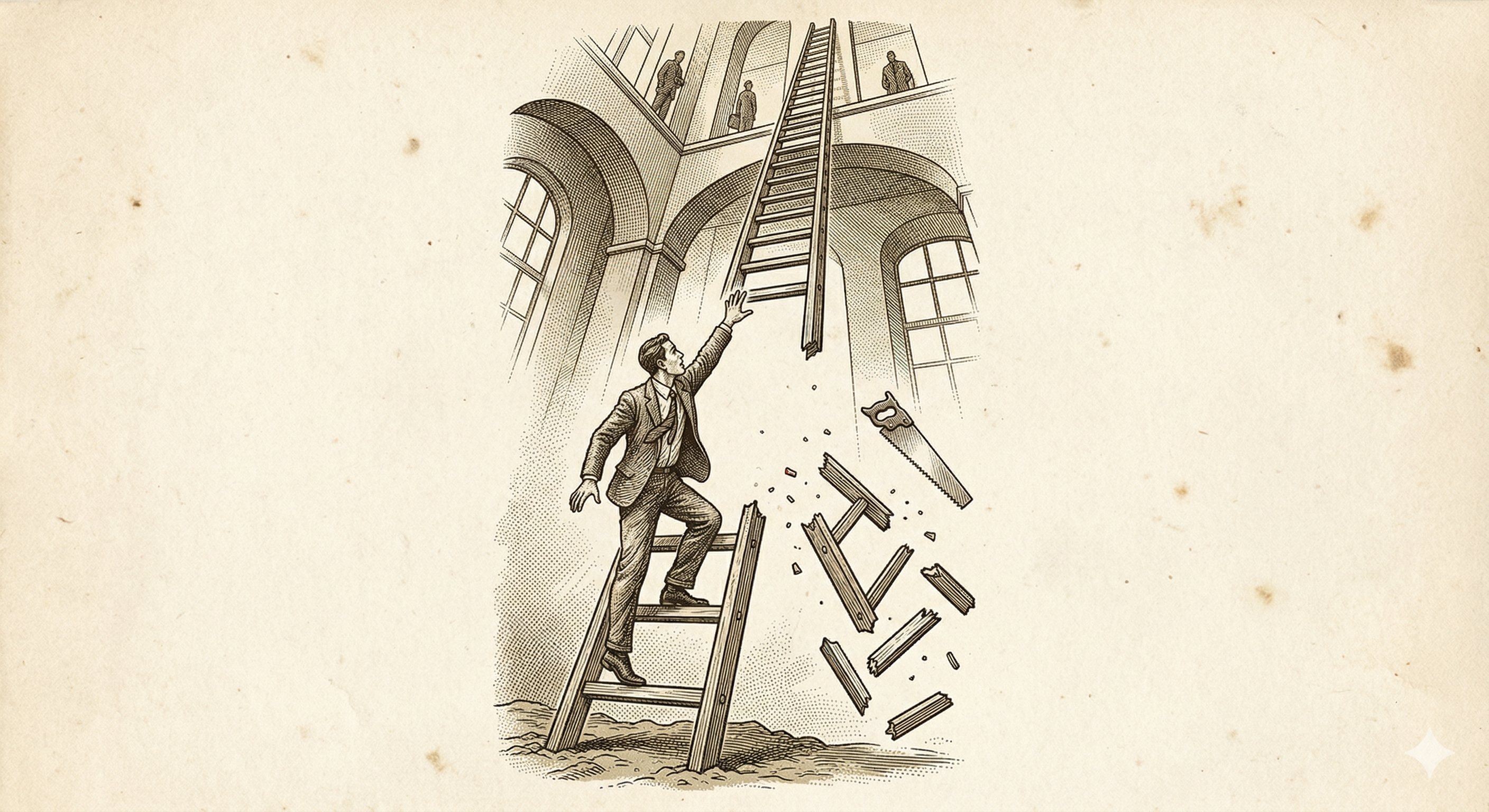
The logic sounds abstract until it hits your industry. Block, a payments company valued at $13 billion, cut 40 percent of its workforce in 2024. But that was not what hurt: Atlassian, a software darling, eliminated 1,600 roles while hiring 800 AI-focused ones. Amazon cut 30,000 corporate jobs. Google cut 12,000. Meta cut 21,000.
The pattern is consistent. The cuts are not coming from below. They are coming from the middle and the ground level. Support roles. Junior positions. The jobs that exist to teach people how to do harder jobs.
A paralegal used to be an entry point to law. You did grunt work—document review, basic research—and you learned. A medical coder transcribed physician notes and gained expertise. A customer support representative moved into product, then sales, then management. The entry-level job was the subsidy for professional development. The company paid for your apprenticeship, and in exchange, you worked cheap.
Those jobs are now automated. Or they are filled by AI with a human QA specialist reviewing the output. The human who used to do the work for $35,000 a year with training is replaced by a human who reviews AI output for $65,000 a year with specialized AI training.
The paralegals facing an 80 percent automation risk are not being laid off yet. Many are being asked to become QA specialists, which is to say: learn to evaluate AI work instead of doing it yourself. This requires different skills, different training, and an entirely different cognitive approach to the work. Some people make the transition. Many do not.
The career consequence is profound. A young person today cannot break into law through paralegal work anymore. They cannot break into medicine through medical coding. They cannot break into software through support or QA. The apprenticeship roles are gone. The proving ground is closed.
Meanwhile, young workers are making the logical conclusion: if I need to arrive at entry level already knowing how to work with AI, why would I break into a field that is automating away from me? Bureau of Labor Statistics data shows workers under 25 are exiting AI-exposed fields faster than older cohorts. They sense the closure. They are leaving.
The wage premium for AI skills is now 56 percent. If you can demonstrate real expertise with the tools—not just using them, but knowing their limits, building systems with them, managing their output—you command a massive premium. But there is a bottleneck: you cannot teach that in a two-week course. It requires years of learning adjacent to people who know.
That transfer mechanism is breaking. The companies that used to train people are cutting the training layer. The freelancers who used to mentor people are being replaced by AI. The entry-level jobs that used to be universities are gone.
The Bifurcation
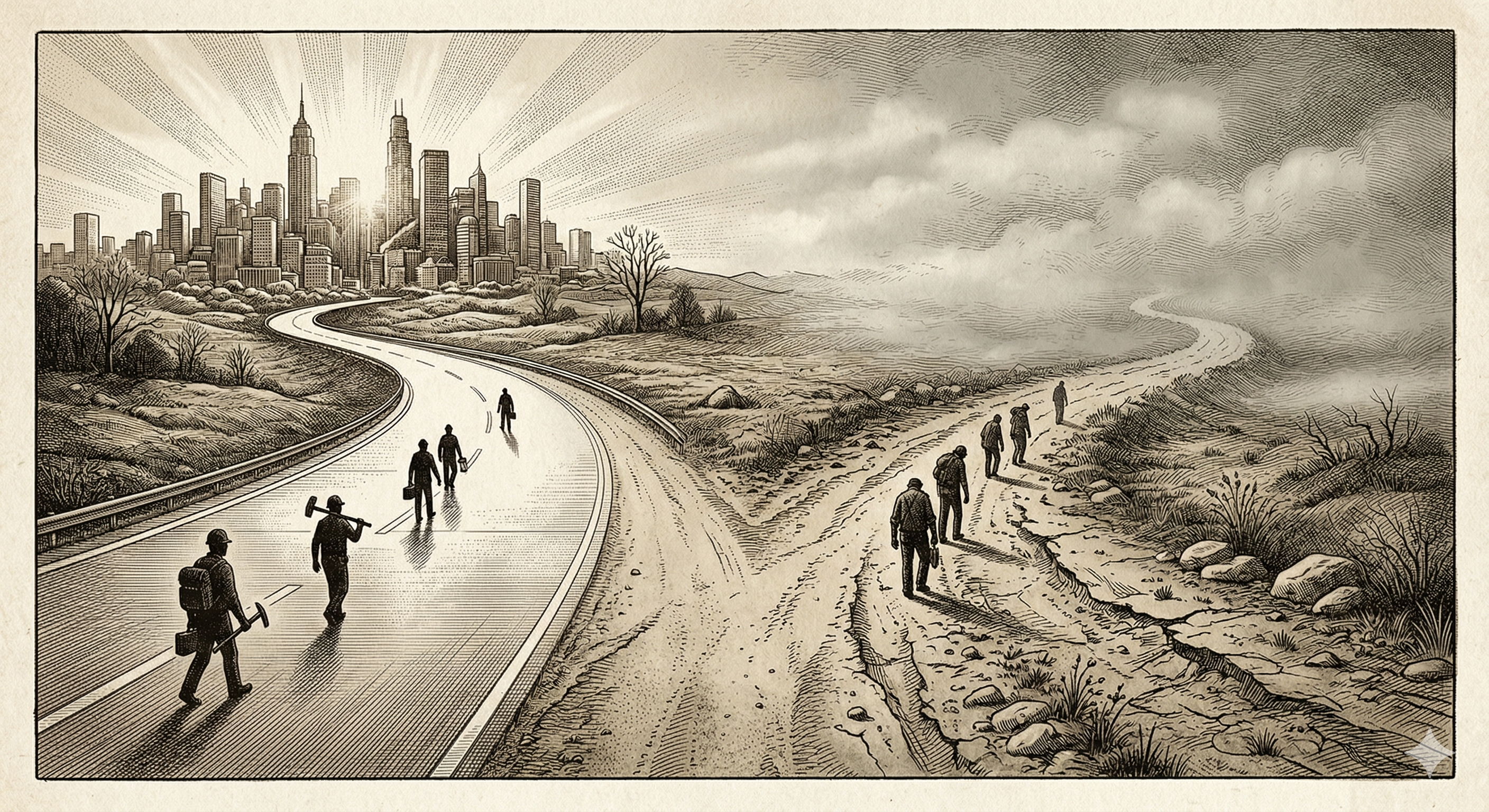
Professional services are not dying. This cannot be said loudly enough, because it is the most important thing that most people get wrong. The World Economic Forum projects that professional services will generate 78 million new jobs by 2030. The sector is growing.
What is happening is not death. It is bifurcation.
The commodity layer—the work that can be specified, that has a clear answer, that requires professional judgment to design but routine execution to deliver—that is going. Fast. The real estate videos, the initial legal review, the technical documentation, the medical transcription, the first draft of anything that follows a template. That is being automated. The price of that work is collapsing to the cost of the tool that does it. The number of people who do that work is falling faster than any occupational decline in modern labor history.
But the judgment layer is not going anywhere. Law firms are not shrinking; they are restructuring. The big ones are laying off junior associates and routine litigators but hiring specialists in AI regulatory law, technology disputes, data privacy. The economics have changed—they are not staffing up three junior lawyers to find one good trial lawyer anymore—but the thing itself is not disappearing.
What is collapsing is the middle. The jobs that existed because you needed a body to do work that was routine but couldn't be fully automated are vanishing. The junior lawyer who learns by doing ten years of document review is not doing that anymore—an AI tool is. The paralegal path to ownership is closing. The way you learn to do a thing by doing a smaller version of it is evaporating.
The new path is different. You either need to arrive at the game with technical expertise and ambition and the good luck to build something yourself, or you need to be excellent enough at the high-judgment part of the work that you command a premium even in a market where basic competence is free.
This sorting is not a single event. It is a decade-long process, and we are in year three. The jobs are still there, but the pathways to them are narrowing. You can still become a lawyer or a doctor or a software engineer. But you cannot become one through the apprenticeship structure that used to exist. You need a different path.
The World Economic Forum's projection of 78 million jobs includes this shift. But the geography of those jobs, the demographics who can access them, the skills required to fill them—all of that is radically different from the jobs they are replacing. A real estate agent in Phoenix does not become an AI prompt engineer. A paralegal does not become a legal technologist without a massive career pivot and probably new credentials.
The six million new AI jobs projected annually by 2030 are specialist roles. They require training that most institutions have not yet figured out how to deliver. They are concentrated in wealthy countries with access to good education. They are paying incredibly well but requiring people who already have substantial technical foundations.
The jobs that are disappearing are distributed. They pay okay—not great, but reliably middle-class. They require a high school diploma and willingness to learn. They exist everywhere. The jobs that are appearing are concentrated, specialist, and require either specialized education or the good fortune to arrive at a company that will train you.
Coda
Return to the scenes we began with. The real estate agent in Phoenix has processed what happened. She saved eleven thousand dollars in the first year. Her agency owner did not give it back to her; instead, he asked her to manage more listings. She can. The tool freed her from production coordination and made her a pure sales and client relations person. This is better and worse for her—more rewarding, more precarious, more dependent on her personality and market timing. She cannot un-discover what she discovered.
The developer in Bangalore built his PDF converter in thirty minutes and shipped it to his client. The project that would have been a two-week contract became a half-day task. He is not unemployed. He is instead dealing with the realization that the rate of delivery has accelerated and the value capture has shifted. He can now build ten times as fast. But the client pays the same rate per project, not per hour. He is wealthier and more stressed.
The father in Texas gave his daughter a practice routine powered by AI. Her piano skills are accelerating. She still needs a teacher for concerts and for the emotional feedback of being in a room with someone who believes in her. But the daily reps, the structure, the accountability—those are being provided by a tool he paid nothing for. The piano teacher in his town will keep her other students but will lose this one. She will adapt or she will leave the profession. Either way, a path has closed that was open yesterday.
The quiet replacement is not a conspiracy. It is not even a corporate strategy. It is individuals discovering what is possible and choosing the efficient option. It is a million decisions made independently and simultaneously, each one locally rational and each one contributing to a phase transition.
The economy after it will not resemble the economy before. The question is whether we build the bridges fast enough—the training systems, the social support, the safety nets that make the transition survivable for the people who did the work we are automating away. The technology does not require this. The market does not reward it. Only policy and intention and collective choice can build it.
The quiet replacement is happening. The question is not whether to stop it. It is what we build on the other side.