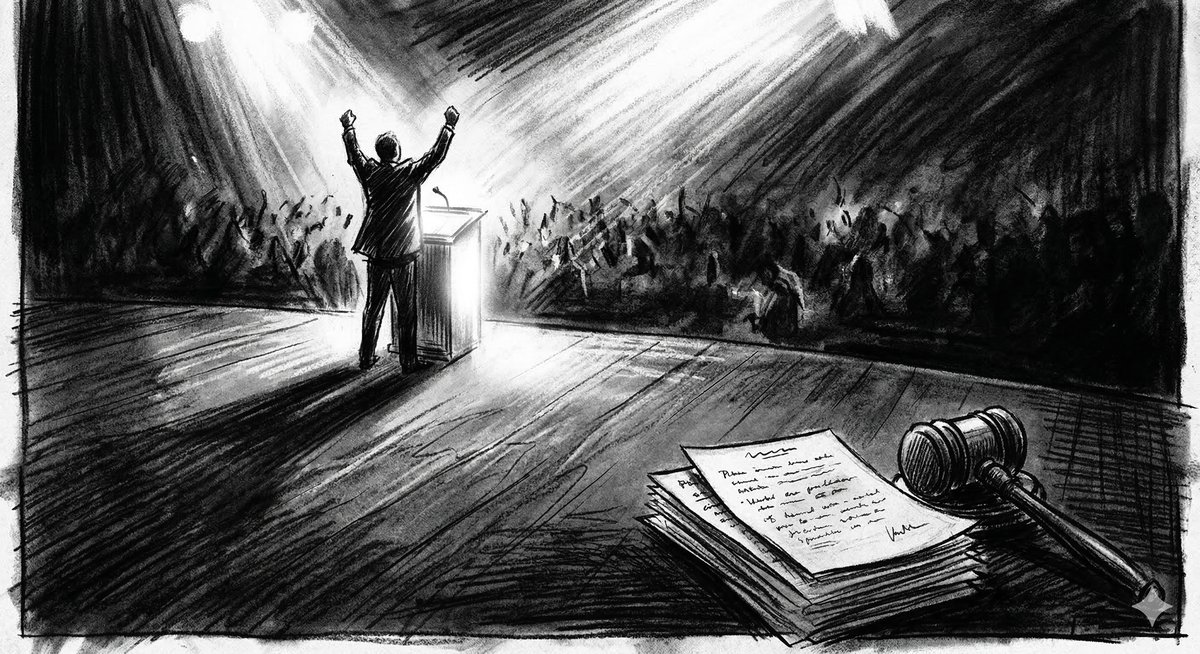
On the morning of March 16, 2026, Jensen Huang took the stage at the GTC conference in San Jose and declared that artificial intelligence had become the operating system of human civilization. Every company in the world, he said, needed what he called a "Claw strategy" — a reference to the software frameworks that let AI agents act autonomously on behalf of businesses and governments. He compared the moment to the early days of the internet. He compared it to the invention of Linux. Huang is not given to understatement, and no one in the packed arena appeared to doubt him.
That same morning, three teenagers in Tennessee were finalizing a federal lawsuit.
The two events — one triumphant, one anguished — arrived on the same Tuesday, and together they describe the central contradiction of artificial intelligence in 2026: a technology moving at a pace that its own creators cannot govern, generating harms that are not theoretical but immediate, not speculative but already in court. The machine has run ahead. The question before us is not whether we can stop it. The question is whether we can catch up.
The Spicy Mode Problem

The lawsuit, filed in federal court in California, named three plaintiffs identified only by their initials. They were teenagers from Tennessee, and they described what had happened to them in language that is not easy to read. Someone — a person they knew, a classmate, the suit does not specify — had taken ordinary photographs of them: school photos, social media posts, the normal documentary evidence of adolescence. Then, using an application powered by xAI's Grok model, that person had stripped off their clothing. The resulting images were sexually explicit. The plaintiffs were minors. Under any legal definition, the images constituted child sexual abuse material.
The images spread. They were shared on Discord and Telegram. According to court documents, some were traded in exchange for other CSAM — a small economy of degradation, built on a foundation of machine learning.
The feature at the center of the lawsuit is called "spicy mode," and it is not a metaphor. Grok, the AI assistant developed by Elon Musk's company xAI, introduced this mode last year. It allowed users to request the removal of clothing from photographs of women without requiring consent from those women. The feature attracted immediate attention and almost immediate controversy. It was, critics noted, a commercial product designed to facilitate the non-consensual sexualization of people who had not agreed to be sexualized.
"The law arrives to address yesterday's injury while today's is already in progress."
What makes the xAI case notable is not just the harm — though the harm is serious — but the gap it exposes between industry standards. Google's AI image generation tools include digital watermarks, invisible flags embedded in pixels that identify an image as AI-generated. OpenAI's tools do the same. These watermarks are imperfect — they can be stripped — but they represent an acknowledgment that AI-generated images carry a distinct kind of moral weight, that their provenance matters. As of the filing of the lawsuit, xAI had adopted no such standard.
The DEFIANCE Act — which stands, with baroque legislative elegance, for Disrupt Explicit Forged Images and Non-Consensual Edits — passed the U.S. Senate unanimously in January 2026. The law created a federal right of action: victims of non-consensual sexually explicit deepfakes can now sue the creators, the distributors, and the platforms that knowingly host such content. It was hailed as a landmark. The Tennessee teens filed their lawsuit nine weeks after DEFIANCE became law. The images of them had been made before the law existed. The law, it turned out, had arrived to address a harm that had already occurred. This is the rhythm of accountability in the AI age: the law arrives to address yesterday's injury while today's is already in progress.
Whose Face Is It, Anyway?
The senators who passed DEFIANCE were the same senators who, one month later, wrote a letter to ByteDance demanding the immediate shutdown of Seedance 2.0. Blackburn and Welch again, this time joined by colleagues, this time focused not on non-consensual nudity but on non-consensual everything.
Seedance is a video generation application developed by ByteDance, the Chinese technology company that also operates TikTok. It is, by technical standards, impressive. Users can input a prompt — a description, a few reference images — and receive back a convincing video. The demonstration videos ByteDance circulated to promote the product showed an AI-generated Thanos and Superman in battle. They showed an alternate ending to Stranger Things. They showed realistic video of actors who had not agreed to appear in anything.
"This app poses a direct threat to the American intellectual property system," the senators wrote. What they meant was that Seedance could generate convincing videos using the likenesses of living actors without those actors' consent, and using copyrighted visual language — the Marvel aesthetic, the Netflix look — without licensing fees. They meant that the economic infrastructure of American entertainment, which has spent a century building legal protections around the value of a face, was being circumvented at machine speed.
"The business model of generative AI requires training on the world's creative output and generating new output that resembles it. The legal frameworks governing that process are, at best, being litigated."
ByteDance responded with the language that has become the tech industry's reflexive grammar in these situations: "We respect intellectual property rights," the company said, "and are taking steps to strengthen current safeguards." The company then delayed the global rollout of Seedance 2.0. What is worth noting is the architecture of that sentence. The company says it respects intellectual property. It is also, apparently, building a product that raises concerns about intellectual property serious enough to delay its launch. Both things are true simultaneously. This is not hypocrisy exactly — it is something more systemic. The company is operating in a space where "respect" and "infringement" have not yet been fully distinguished.
In Hollywood, this is understood as an existential crisis. The question of whether AI can legally replicate a human face — and whose face that is, and who profits from it — is the same question that threatened to shut down the entertainment industry during the writers' and actors' strikes of recent years. Those strikes produced agreements that were meant to address AI. The agreements, it is already clear, did not fully address AI. The technology moved faster than the contract.
The Deepfaked Dead

The hardest story of this week requires more than a moment's attention, because it involves real children who are real dead, and images that were not.
On February 28, 2026, in the opening hours of a military operation by the United States and Israel against Iran, a missile struck a girls' school in Minab, a coastal city in southern Iran. More than 170 people died. Most of them were schoolgirls. The youngest victims were reported to be eight years old.
The event was real. It was documented by Iranian state media, by international journalists, by satellite imagery, and by the kind of slow, terrible accumulation of testimony that attends a mass casualty event in the age of social media. No serious analyst disputes that a school in Minab was bombed on February 28 and that children died there.
What followed was something more difficult. Beginning on March 3, an image began circulating on social media platforms. It showed Iranians mourning at a graveyard, grief-stricken figures bent over small graves. The image was arresting. It was shared on X, on Telegram, on Facebook, by millions of people trying to process what had happened in Minab. It appeared in news coverage. It illustrated the reality of what had been done.
Google's SynthID watermarking tool later confirmed that the image had been generated by AI.
"The death of real children was illustrated with fabricated imagery, and the fabricated imagery traveled alongside the real testimony until it was nearly impossible to tell which was which."
Neither image had been made by the Iranian government. Neither was made by the U.S. government. They appear to have been generated by actors unknown, for reasons that are not entirely clear — perhaps to amplify grief, perhaps to manufacture it, perhaps simply because generating emotionally resonant images of tragedy has become trivially easy and the incentives to deploy them are varied and often impossible to trace. What is clear is the effect: the death of real children was illustrated with fabricated imagery, and the fabricated imagery traveled alongside the real testimony until it was nearly impossible to tell which was which.
This is the epistemological crisis that AI has accelerated to a pace that our institutions cannot match. Photographs have been falsifiable since the darkroom. But the effort required to convincingly fake an image of mass grief — the equipment, the expertise, the time — once served as a partial brake on the volume of falsified imagery. That brake is gone. The images are easy now. The detection tools exist — SynthID, Content Credentials, a small ecosystem of verification instruments — but they are not integrated into the platforms where the images spread. The verification happens afterward, in fact-checks published to audiences far smaller than those that saw the original.
Bengaluru's Long Reckoning
The harms described above involve images: their generation, their spread, their consequences. But the most numerically significant harm of AI's current wave is also the most invisible to the people writing about it from offices in San Francisco and New York. It is the disruption of India's technology workforce.
India's information technology outsourcing sector employs approximately 5.8 million people. It generates roughly $300 billion in annual revenue. It is the backbone of a middle class that emerged over the past thirty years from the combination of English-language education, cheap labor, and the peculiar demand of global corporations for back-office work that could be done anywhere in the world with a reliable internet connection. The sector built Bengaluru, once a garden city and now a metropolis of glass towers and gridlock. It is, in some ways, the largest single product of the last era of globalization.
Vinod Khosla, the venture capitalist who helped found Sun Microsystems, said at the India AI Impact Summit in February 2026 that the sector could "almost completely disappear" within five years. Tata Consultancy Services, the largest IT company in India, has cut its headcount by more than twenty thousand employees from its 2022 peak. Its total workforce is now below 580,000 for the first time in years.
"The jobs being destroyed are being destroyed now. The jobs being created require skills that the current workforce does not have and that will take years to develop."
The BBC's Nikhil Inamdar spent time in Bengaluru recently and returned with a story that is harder to summarize than a revenue chart. He found engineers who had been told their roles were being automated and who were struggling to identify what role, if any, the new economy had for them. He found companies that had slowed hiring to a trickle. He found young people whose families had sacrificed to pay for computer science degrees in the expectation that those degrees would produce the kind of stable, middle-class life that the previous generation of IT workers had achieved.
Rest of World documented something more acute: a crisis among Indian tech workers involving layoffs, mental health deterioration, and, in some cases, suicide. The sector that had served as an argument for globalization's benefits — that digital work could be done anywhere, that talent in Bengaluru was as valuable as talent in Boston — is now serving as an argument for globalization's fragility. The talent is still there. The demand is going away.
The optimists point out that AI will create jobs as well as destroy them. Infosys has argued that AI might eliminate 92 million jobs but create 170 million new ones. The numbers are not obviously wrong. But the timeline matters enormously. The jobs being destroyed are being destroyed now. The jobs being created require skills — AI engineering, data annotation at scale, prompt architecture — that the current workforce does not have and that will take years to develop. In the gap between those two timelines live millions of people whose livelihoods are ending before the new ones have been built.
The Legislators Sprint

In January 2026, the U.S. Senate passed the DEFIANCE Act unanimously. In December 2025, the European Commission published its first draft Code of Practice on AI-Generated Content Transparency, requiring watermarking and metadata tagging for AI outputs. Oregon, in March 2026, passed chatbot safety legislation. A dozen state legislatures are considering deepfake bills. The EU AI Act's transparency provisions are scheduled to take effect in August.
This is not nothing. The pace of AI-related legislation in 2025 and early 2026 is, by historical standards, quite fast. The European Union moved from concept to binding law in three years — a speed that the GDPR, which took four years, was once considered remarkable for. The DEFIANCE Act passed the Senate without a single dissenting vote, a rarity in American politics regardless of subject matter.
But the legislation is, in almost every case, built in response to harms that have already occurred and technologies that have already deployed. The DEFIANCE Act was written in response to cases like the Tennessee teenagers'. The EU's watermarking code was written after years of AI-generated imagery spreading without attribution. The laws describe the world as it was when they were drafted; the technology describes a world that has moved on.
The gap between the world the laws describe and the world the technology inhabits is not a failure of the legislators. Blackburn and Welch and the EU's technical drafters are, by any fair assessment, trying seriously. The gap is a structural feature of the situation. Legislation requires consensus, and consensus takes time, and time is the one resource that the AI industry has decided it does not need to wait for. The DEFIANCE Act took roughly three years from introduction to passage. In those three years, the tools it addresses became cheap, ubiquitous, and embedded in applications used by millions. The law caught up to a world that had already changed.
The EU's watermarking requirement may help. SynthID, which identified the fake images from Iran, suggests that technical interventions can work when they are deployed consistently. The question is consistency: Google's tools are watermarked; xAI's are not; the images spread in the gap between them.
There is a thing that happens at technology conferences that is worth noting. The audience is shown a vision of the future that is transformative and exciting and, above all, fast. Jensen Huang showed it at GTC: agents everywhere, AI in every company, the operating system of civilization rewritten. The audience applauds. The demonstration is compelling. The vision may even be accurate.
What the demonstrations do not show is the margin. Not the margin of the conference center, but the margin of the world — the places where the technology arrives before the governance, where the exciting use case and the harmful one are built on the same model, where the 170 dead schoolgirls are mourned with images that a neural network invented. The margin is where the three teenagers in Tennessee live. It is where the engineers in Bengaluru are sitting with degrees that have suddenly lost their value. It is where every social media user who saw an image of Iranian grief and could not tell whether it was real was trying to hold onto the idea that the world can still be known.
The machine is not malicious. This is worth saying clearly. The people building it are, in most cases, neither stupid nor evil. Some of them are genuinely worried about the harms and are building, slowly, the watermarks and the verification tools and the impact assessments that might help. The DEFIANCE Act passed unanimously. The EU code of practice was drafted by people who spent years consulting experts. The impulse toward responsibility is real.
What is also real is that the impulse toward responsibility is losing the race. The tools of harm are deployed at the speed of a model release; the tools of governance are deployed at the speed of Senate consensus. These are not compatible speeds. The teenagers in Tennessee filed their lawsuit in 2026. The images were made before any law could have stopped them.
Every week now arrives with its version of this asymmetry. The conference announces the future. The lawsuits describe the present. The legislators are sprinting between them, trying to draft a law for a world that keeps changing underneath their feet.
The machine is already ahead. The question is not whether we can stop it. The question is whether we can decide, as a society, what we owe to the people it is running past.